Latest Info on Egypt gov spend, Public Purchasing, Govt budget & Public spending
- Home >
- Public Procurement
Public Procurement in the Arab Republic of Egypt
Public procurement in the Arab Republic of Egypt represents one of the largest and most strategic government markets in the Middle East and North Africa (MENA) region. With a population exceeding 110 million and a diversified economy, public procurement is a critical instrument for implementing national development plans, delivering public services, and supporting large-scale infrastructure and social programs.
Egypt operates a centralized and legally mature public procurement system, anchored in a modern procurement law adopted in 2018. The system emphasizes transparency, competition, domestic industry support, and sustainability considerations, while gradually expanding the use of electronic procurement tools.
For domestic suppliers and international firms, Public Procurement in Egypt offers a high-volume, rules-based market covering nearly all economic sectors, including infrastructure, energy, healthcare, education, transport, and digital services.
Country & Economic Overview
| Country | Arab Republic of Egypt |
| Region | Middle East and North Africa (MENA) |
| Population (2024) | 110.99 million |
| Income Level | Lower middle-income economy |
| Gross Domestic Product (USD, 2024) | USD 389.06 billion |
| Gross National Income (USD, 2024) | USD 371.52 billion |
| GNI per Capita (USD, 2024) | USD 3,510 |
| Base Currency | Egyptian Pound (EGP) |
Egypt is an active member of major international and regional organizations, including the IMF, WTO, AfDB, EBRD, IFAD, and UNCTAD, and maintains extensive engagement with multilateral development partners.
Institutional & Governance Framework
The Egyptian public procurement system is highly centralized. The Ministry of Finance is the lead authority responsible for procurement policy, oversight, and central purchasing functions.
| Public Procurement Authority | Ministry of Finance - General Authority for Government Services (GAGS) |
| Role | Central Purchasing Body and procurement regulator |
| Scope | National |
| Sectors Covered | Agriculture, Education, Energy, Health, Transport, ICT, Water & Sanitation, Social Protection, Public Administration |
GAGS operates as the Central Purchasing Body (CPB), consolidating demand for common-use goods and services and supporting economies of scale across government entities.
Legal & Regulatory Framework
Public procurement in Egypt is governed by Law No. 182 of 2018 on the Regulation of Contracts Concluded by Public Authorities, along with its Executive Regulations. This law replaced earlier fragmented frameworks and introduced a unified, modern procurement regime.
Key features of the legal framework include:
- Clear definition of procurement methods and procedures
- Mandatory planning and budget alignment
- Strong administrative oversight and accountability
- Explicit provisions for SME participation and domestic preference
The law establishes rules for bid securities, bid openings, bid validity, direct contracting thresholds, and complaint handling mechanisms.
Procurement Procedures & Contracting Practices
Egyptian procurement procedures follow a structured process, typically including:
- Annual procurement planning
- Public advertisement of tenders
- Competitive bidding as the default method
- Public bid opening sessions
- Technical and financial evaluation
- Formal contract award and disclosure
Domestic preference provisions exist to support national industries, while specific articles of the law reserve opportunities and incentives for small and medium-sized enterprises (SMEs).
Direct contracting is permitted under defined circumstances and monetary thresholds, particularly for emergencies, monopolistic supply situations, or low-value contracts.
E-Procurement & Digital Systems
Egypt operates a long-standing national electronic procurement platform known as the Government Procurement Portal, launched in 2007.
| eProcurement System | Government Procurement Portal |
| Website | https://etenders.gov.eg/ |
| Key Functionalities | ePublishing, Tender Notification, eTendering, eQuotations |
| Languages | Arabic, English |
The portal serves as the official platform for publishing tenders and accessing bidding documents. While not all procurement transactions are fully digitized, the system significantly enhances transparency and access to government tenders.
Procurement Market Size & Characteristics
Given the scale of Egypt’s public sector, procurement expenditure represents a substantial share of public spending, although consolidated statistics on procurement as a percentage of GDP are not publicly disclosed.
The procurement market is characterized by:
- High volume of contracts across multiple sectors
- Strong role of central government entities
- Large infrastructure and public works projects
- Growing participation of international suppliers, especially in donor-financed projects
Transparency, Complaints & Oversight
The procurement law provides formal mechanisms for complaints and dispute resolution, including defined timelines and administrative review procedures.
Procurement notices, awards, and regulatory guidance are published through the Ministry of Finance and the Government Procurement Portal. Annual financial and procurement-related reports are issued by the Ministry of Finance.
Sustainability & Social Policy Objectives
Egypt has taken steps toward sustainable and green public procurement, supported by national strategies and international cooperation initiatives such as SwitchMed.
Although green procurement practices are not yet mandatory under Law No. 182/2018, sustainability considerations are referenced in the law and executive regulations. Sector-specific tools, guidelines, and national action plans on sustainable consumption and production have been developed, and future regulatory integration of green procurement standards is under consideration.
Practical Insights for Suppliers
Suppliers seeking to participate in public procurement in Egypt should note the following:
- Arabic is the primary language of procurement documentation
- Registration on the Government Procurement Portal is essential
- Strict compliance with administrative and legal requirements is critical
- Local presence or partnerships can significantly enhance competitiveness
- SMEs benefit from specific legal protections and incentives
In conclusion, Public Procurement in the Arab Republic of Egypt is a large, centralized, and strategically important market. Backed by a modern legal framework and a national eProcurement portal, it offers substantial opportunities for qualified suppliers while continuing to evolve toward greater digitalization and sustainability.
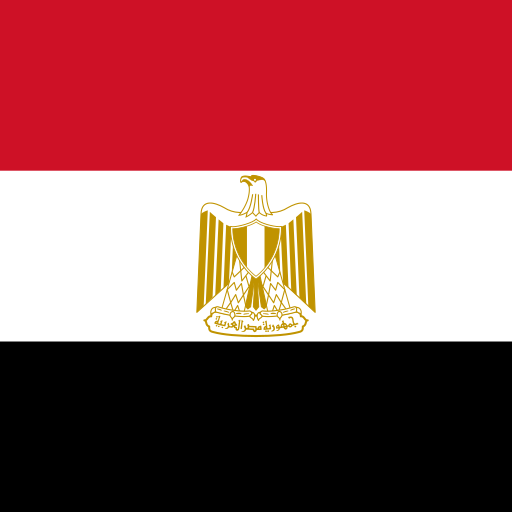
Flag of Egypt

Emblem of Egypt
Capital
Cairo
ISO 3166 Code
EG
Population
87,825,400
Area, Sq KM
1,001,450
Currency
Egyptian pound
GDP, Billion USD
2,71,973
Language
Arabic
GDP Growth Rate, %
2.2
Inflation, Avg CP, %
8.75
Interest Rates, %
-
Unemployement Rate, %
12.98
Exchange Rate, 1 USD Equals
7.62
International dial code
20
Time ZONE
GMT+02:00
Internet TLD
.eg
Get FREE SAMPLE TENDERS from Egypt in your email inbox.
Copyright © 2014-2026 egypttenders.com. All Rights Reserved.